
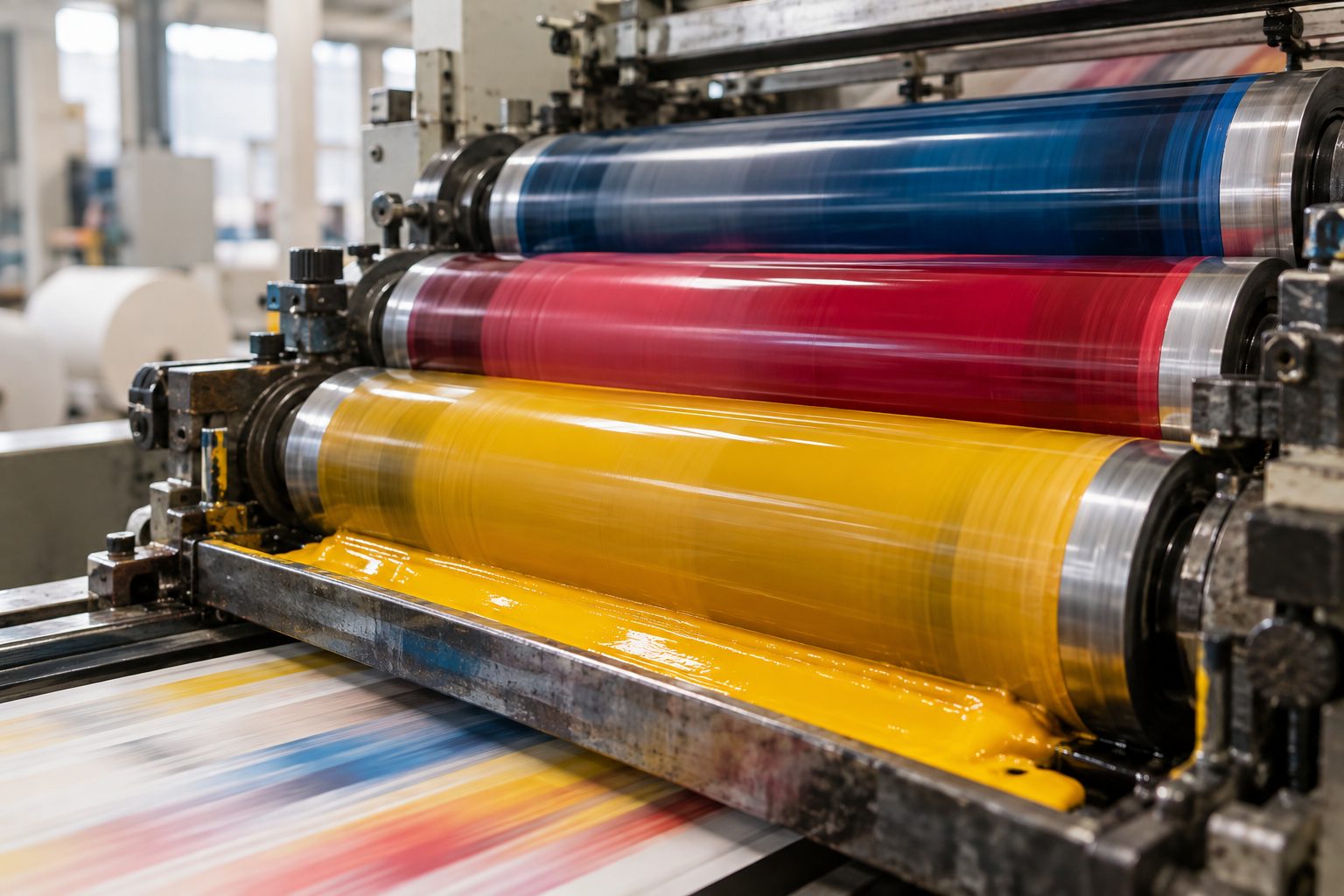
Newspapers and magazines have shrunk, yet the printing ink industry keeps growing. The reason is on every supermarket shelf: flexible packaging, labels and cartons. This note looks at the global ink market, Türkiye's strength as a packaging exporter and the raw materials that make flexo and gravure inks work.
The Global Picture
Mordor Intelligence values the global printing inks market at about US$19.2 billion in 2026 and expects it to reach around US$22.3 billion by 2031, a growth rate of roughly 3 percent a year. Packaging is the engine: it accounted for about 55 percent of ink demand in 2025 and is growing faster than the market as a whole. Other research houses put the packaging share lower, but all agree on the direction.
Flexography and gravure dominate packaging print. Both use fluid, fast drying inks that have to stick to plastic films, foils and paper, survive lamination and folding, and meet food contact rules.
Türkiye: A Packaging Exporter
Türkiye is a net exporter of packaging, and printed film is a large part of that trade. According to the Turkish Packaging Manufacturers Association (ASD), packaging exports reached US$7.3 billion and 3.4 million tonnes in 2025, against imports of US$4.3 billion, a trade surplus of about US$3 billion. Plastic packaging alone was worth US$4.67 billion, 64 percent of the total, followed by paper and board at US$1.74 billion. The largest markets were the United Kingdom, Germany, the United States, Italy and Iraq.
What Goes Into a Packaging Ink
- Nitrocellulose is the classic binder of solvent based flexo and gravure inks. It dries quickly even at low temperatures, wets a wide range of pigments and adheres well to polyethylene, polypropylene, polyester and metallised films, while staying flexible through folding and lamination.
- Pigments give colour and opacity: titanium dioxide for white backing, high colour carbon blacks for deep black, phthalocyanine blue and green for process and brand colours.
- Resins such as polyamide, hydrocarbon and rosin based resins adjust adhesion, gloss and resistance for each substrate.
- Additives such as waxes and matting agents control slip, scuff resistance and appearance.
Nitrocellulose is not the answer for every job. For demanding laminates that face heat or long UV exposure, some converters move to polyurethane systems. For most surface printing and many laminating applications, nitrocellulose based inks remain the standard because they print fast and run reliably on existing presses.
What This Means for Buyers
An ink maker needs the right nitrocellulose type and viscosity grade (ester soluble RS or alcohol soluble SS), consistent pigment quality and complete documentation for food packaging customers. Gültaş Kimya supplies nitrocellulose in wetted, plasticised and chip forms from a leading producer, together with carbon black, phthalocyanine pigments, titanium dioxide and polyamide resins, from stock in our Çayırova, Kocaeli warehouse.